
The short answer
Planning your first festival trip on the other side of the world is mostly a logistics puzzle. This guide covers the practical parts: how to reach the site from an overseas arrival point, how registration and ticket sales work, what living on a huge greenfield site is actually like, and how to pack for weather that will not cooperate. You will also find a planning checklist, a budget outline, and the small details that separate a smooth first year from a stressful one.

Where and when the festival happens
The festival is held at Worthy Farm in Pilton, Somerset, in southwest England, and it typically runs in late June. It is not in the town of Glastonbury; the farm sits several miles away, so plan the two as separate stops.
Confirm the exact dates and gate opening times on the official Glastonbury site before you book flights, because they move slightly from one summer to the next.
The festival has run since 1970, and it takes occasional fallow years when the farm rests. Check that an edition is actually happening before you build a long-haul trip around it.
The week has a shape worth knowing. Gates usually open on the Wednesday and the site runs through to Sunday night, with the biggest music days on Friday, Saturday and Sunday. Monday is for packing up, queueing out and saying goodbye to the mud.
Getting to the festival from Australia
There are no direct flights from Australia to Somerset, so the standard route is a long-haul flight into London, then a train or coach west to the site. Most itineraries land at Heathrow or Gatwick, and some routings connect through a hub into Bristol, which is the closest of the main arrival airports to the farm.
The time difference runs roughly nine hours from the east coast, and a festival is a physical week. Build in two or three nights in London before you head west. Arriving at the gates straight off a long-haul flight is how people lose the first day of the festival to exhaustion.
Before you book, sort your entry paperwork. Australian passport holders can visit the UK for up to six months without a visa, but you need a UK Electronic Travel Authorisation before you fly. Check the current rules and fee on GOV.UK and apply well before your departure date.
Money is the last piece. You will spend in pounds, and cards and phones work nearly everywhere on site, so you only need a small amount of cash for edge cases. Long-haul baggage allowances are tight, which is one more reason to buy bulky camping gear after you land rather than drag it from Australia.
The international festival travel planning guide covers the wider trip, from passports to insurance.
What the site is actually like
Worthy Farm becomes a temporary city for the week, and the scale surprises every first-timer. There are dozens of stages and areas: the Pyramid Stage for the biggest sets, the Other Stage, West Holts, the Park, Silver Hayes, the late-night dance fields, plus theatre, circus, crafts and food areas spread across the site.
A greenfield festival just means it is built on farmland, with temporary stages and camping in the fields around them. That has practical consequences. Expect long walks between stages and back to your tent, gentle hills in places, and paths that change character with the weather.
The food is one of the quiet highlights. Stalls cover everything from breakfast rolls to full dinners, with plenty of vegetarian and vegan options, and prices sit at festival level rather than restaurant level.
The week runs in two gears. Wednesday and Thursday are for setting up camp and wandering; from Friday the headline sets and the biggest crowds arrive. Keep the first two days loose and plan your priority acts for the weekend.
Phone signal is patchy once the site is full, and that catches out groups every year. Agree a meeting point and a fallback time before you split up, and treat your phone as a bonus rather than the plan.
Weather at Glastonbury and how to handle it
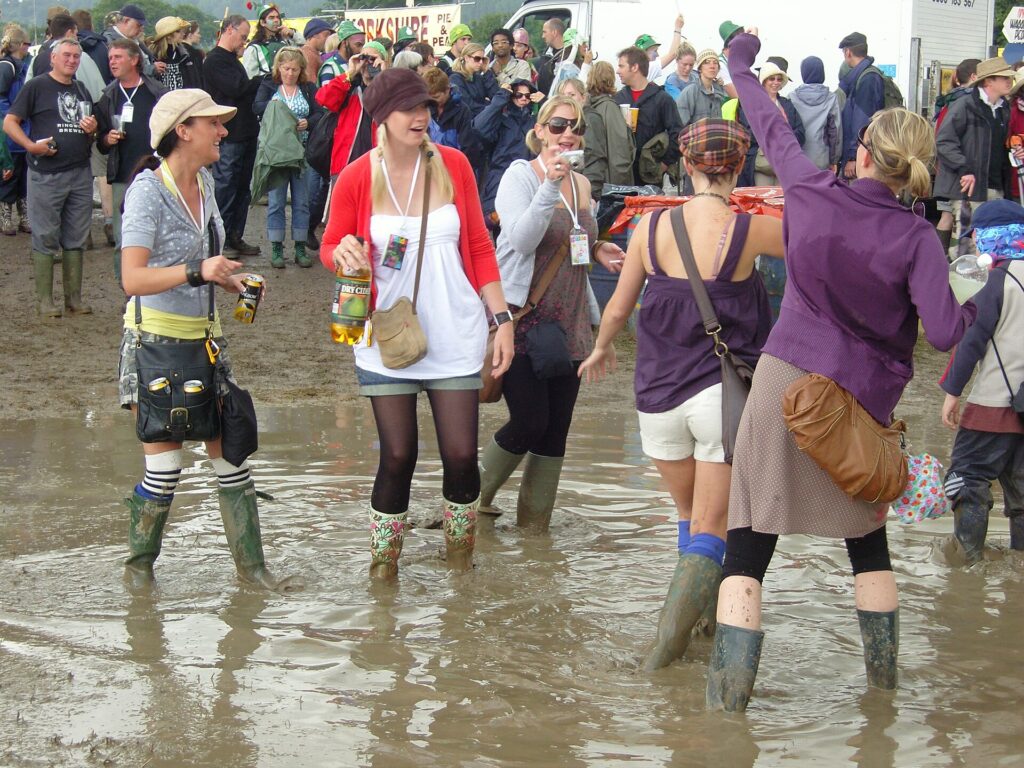
Expect a mix: mild sunny afternoons, cold nights, wind, and rain that can arrive on any day of the week. The festival sits on working farmland, and one wet day turns the main paths into deep mud. That is why footwear and waterproofs matter more than any other gear choice.
Dress in layers you can shed by afternoon and add after dark, because temperatures swing hard between day and night. Keep your sleeping bag and spare clothes inside dry bags, so a wet tent floor does not ruin the second half of your week.
Take sun protection seriously as well. When the sun comes out, the open fields have almost no shade, and a full day on your feet in it catches people out.
What to pack for Glastonbury
Pack for camping in changeable weather and for carrying everything yourself from the car park or shuttle drop-off to your pitch. That means a load you can actually move: a folding trolley or small wagon for the gear run is the classic first-timer trick, and it saves two or three exhausting trips.
| Pack this | Why it matters |
|---|---|
| Waterproof tent with a full flysheet | A cheap festival tent that leaks will ruin your week |
| Wellington boots or waterproof boots | The site is farmland; trainers will not survive a wet day |
| Waterproof jacket | Rain arrives quickly and ponchos tear in the wind |
| Warm layers and a hat | Late June nights in England get cold |
| Sleeping bag and mat | The tent will not keep you warm on its own |
| Head torch | Free hands for the walk back to camp after dark |
| Refillable water bottle | Free water points are spread across the site |
| Power bank | Phone charging points are limited and queues are long |
| Earplugs and an eye mask | Campsites are loud and bright at all hours |
| Toilet roll and hand sanitiser | Supplies at the portable toilets can run low by evening |
| Dry bags | Waterproofing for your sleeping bag and spare clothes |
If you are flying in, do the maths on baggage fees before you pack half a camping shop. Basic tents, wellington boots and sleeping bags are easy to buy in the UK, and the town of Glastonbury has shops for last-minute supplies. Leave glass at home; it is banned on site.
Our festival packing list goes deeper on the full kit.
Getting to the site from London or Bristol
Most overseas visitors reach the farm by train and shuttle or by coach, and both beat driving if you are new to UK roads. Here is how the main options compare.
| Option | How it works | Best for | Watch out for |
|---|---|---|---|
| Train plus shuttle | Rail from London or Bristol toward the southwest, then the festival shuttle from the nearest station | First-timers without a car | Station and shuttle details change each year; confirm them on the official site |
| Coach | Services run from London and other UK cities and drop you near the gates | Heavy bags and no changes | Popular departure slots sell out quickly |
| Car | Drive to the festival car parks, then carry your gear in | Groups with a lot of kit | Very long arrival queues; buy parking in advance |
| Taxi or private transfer | Drop-off points sit away from the gates | Late-night arrivals | Road closures and festival traffic near the site |
The nearest railway station to the site has traditionally been Castle Cary, with shuttle buses running between the station and the festival gates. Treat that as the starting point, not the final answer: transport plans are rebuilt for every edition, so confirm the current route once you have tickets. The festival transportation options compared breaks the trade-offs down further.
Tickets, registration and resale
You cannot buy a ticket at the gate. You register in advance, then buy in a scheduled online sale, and recent sales have sold out within minutes. The registration is free and includes a photo, and it has to be done before the sale opens, not on the day.
Treat the mechanics as a moving target. Registration windows, sale dates, deposit schemes and resale events are all announced on the official site each cycle, and they have changed from year to year. Confirm the current process before you plan around it, and only buy through official channels.
Tickets carry your name and photo, and unofficial sellers are a common scam.
If you miss the main sale, the official resale is the realistic second chance, and it usually lands in the spring before the festival. Coach packages bundle a ticket with travel from a set departure city, which can solve two problems at once if you are coming from overseas. Our festival ticket buying strategies for sellouts covers the tactics in detail.
Where to stay during the festival
Most people camp on site, and a standard weekend ticket includes access to the camping fields, so the default plan is a tent you own or borrow.
A pitch is not reserved, so arrive on the day the gates open for the widest choice, and pick your field around your evenings: near the late-night areas if you will be out late, further out if you value sleep.
The alternatives all have trade-offs. Pre-pitched and glamping options cost more and sell out early; if you are flying, renting a pre-pitched tent removes a big chunk of luggage. Campervan fields need a separate pass.
Hotels and guesthouses in Glastonbury town, Wells, Shepton Mallet and Street fill up early, sometimes a year ahead, and you still face the daily trip in and out of a site ringed by festival traffic.

Adding days around the festival: Glastonbury town and the Tor
The town of Glastonbury, a few miles from the farm, is worth a day before or after the festival, and it doubles as your last-chance supply run. Climb the Tor for the view from the tower on top, walk the Abbey ruins, and visit Chalice Well Gardens and the White Spring at the foot of the hill.
The town leans on the King Arthur and Avalon legends; the Abbey is the reputed burial place of Arthur and Guinevere, and the stories are half the reason people visit. Travel writer Rick Steves rates the Tor climb and the cathedral city of Wells nearby among the area’s core sights in his Glastonbury and Wells guide.
If you have a spare day, Wells is a short drive away and makes an easy half-day trip. The High Street in Glastonbury town, meanwhile, is where you replace the boots you forgot.
What a first Glastonbury trip costs
Flights are the biggest line in the budget for most Australians, followed by the ticket, gear and spending money on site. There is no way around the long-haul airfare, but every other line has a cheaper version if you plan ahead.
- Flights: book as early as you can, avoid the July school holidays, and price a stopover against a direct routing.
- Ticket: full weekend tickets have sat in the several-hundred-pound range in recent years, and a deposit scheme has usually been available. Check the official site for the current price and terms.
- Gear: compare airline baggage fees with buying basic camping kit in the UK after you land.
- UK travel: two or three nights in London plus train or coach fares to the site.
- On-site spending: food, drinks and small comforts add up over five days, so set a daily number and track it.
One rule that saves real money: decide your daily on-site budget in pounds before you leave Australia, and keep the card spending visible. Five days of festival food and drinks is a bigger number than most first-timers guess.
Your first-time planning checklist
Work through these in order and the trip mostly plans itself.
- Confirm the dates, and that the festival is running that year, on the official site.
- Register for tickets, enter the main sale, and line up alerts for the official resale.
- Once you have tickets, book flights and land in London two or three days early.
- Book your route to the site: coach, or train plus shuttle, and your nights in London.
- Sort entry paperwork and travel insurance: UK Electronic Travel Authorisation first.
- Gear up: pack light, and plan to buy bulky items in the UK if you are flying.
- Plan the exit: Monday departures are slow, so book a later flight or an extra night.
Ready to price the whole trip before you book anything? Start with the festival budget breakdown.
Frequently asked questions
Is Glastonbury Festival worth it for a first-timer?
Yes, if you plan around the scale. The site is enormous, the week is physically demanding and the weather can be rough, but first-timers get the full experience: hundreds of acts, food from everywhere and a crowd that treats the week as a ritual.
How far is the festival site from Glastonbury town?
The festival is not in the town. It is held at Worthy Farm in Pilton, several miles away, and there is no practical walk between the two.
Book town accommodation only if you have a car or a lift to the site.
Do you really need wellington boots at Glastonbury?
Not in a dry year, but you should still take them or waterproof boots with grip. The site is farmland, and one wet day turns the paths into mud that ordinary trainers cannot handle.
Cheap wellies bought in the UK are a common solution.
Can you bring your own food and drink into the festival?
Yes, you can bring your own food and drink for personal use, and it is how plenty of people keep costs down. Glass containers are not allowed on site, so decant anything in glass before you arrive.
How early should you arrive on site?
Arrive on the first day the gates open if you want the pick of camping spots; in recent years that has been the Wednesday. The first two days are calmer, so use them for camp setup and exploring before the main music days.
Image credits
- Photo: Tomjhill / Wikimedia Commons, CC BY-SA 4.0. Source
- Photo: Hilary Perkins / Wikimedia Commons, CC BY-SA 2.0. Source
- Photo: Rodw / Wikimedia Commons, CC BY-SA 4.0. Source
- Photo: Marley Sexton / Wikimedia Commons, CC0. Source
Works Cited
“Check if you need a UK visa.” GOV.UK, www.gov.uk/check-uk-visa. Accessed 14 Sept. 2026.
“Glastonbury & Wells.” Rick Steves Europe, www.ricksteves.com/europe/england/glastonbury-wells. Accessed 14 Sept. 2026.
Glastonbury Festivals, www.glastonburyfestivals.co.uk. Accessed 14 Sept. 2026.