
The short answer
Planning a Holi festival trip to India starts with one thing: the date. Holi follows the Hindu calendar, so it moves each year, and the crowds and celebrations move with it. In the north, towns run days of colour, music and water fights; elsewhere the festival takes different forms. This guide covers what Holi is, when it falls, where to see it, what to pack and how to join in without causing offence.
What is Holi?
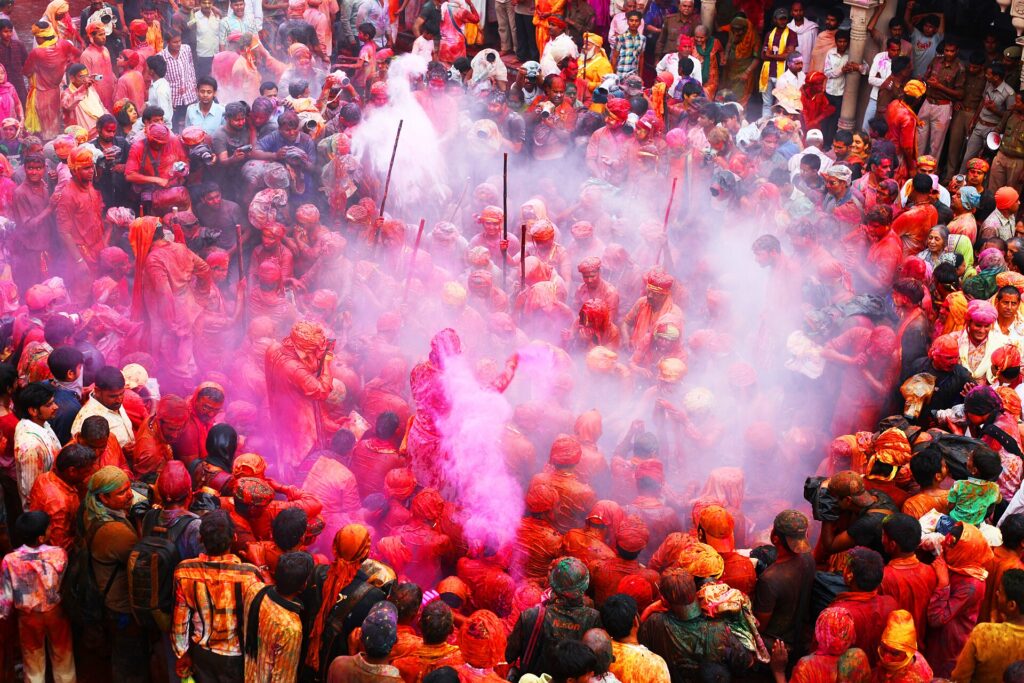
Holi is the Hindu festival of colours, a spring celebration built on colour play, bonfires and shared food. It marks the end of winter, the arrival of spring and the victory of good over evil. In practice it is also a giant public street party, and the one day of the year when nobody minds a stranger covering them in powder.
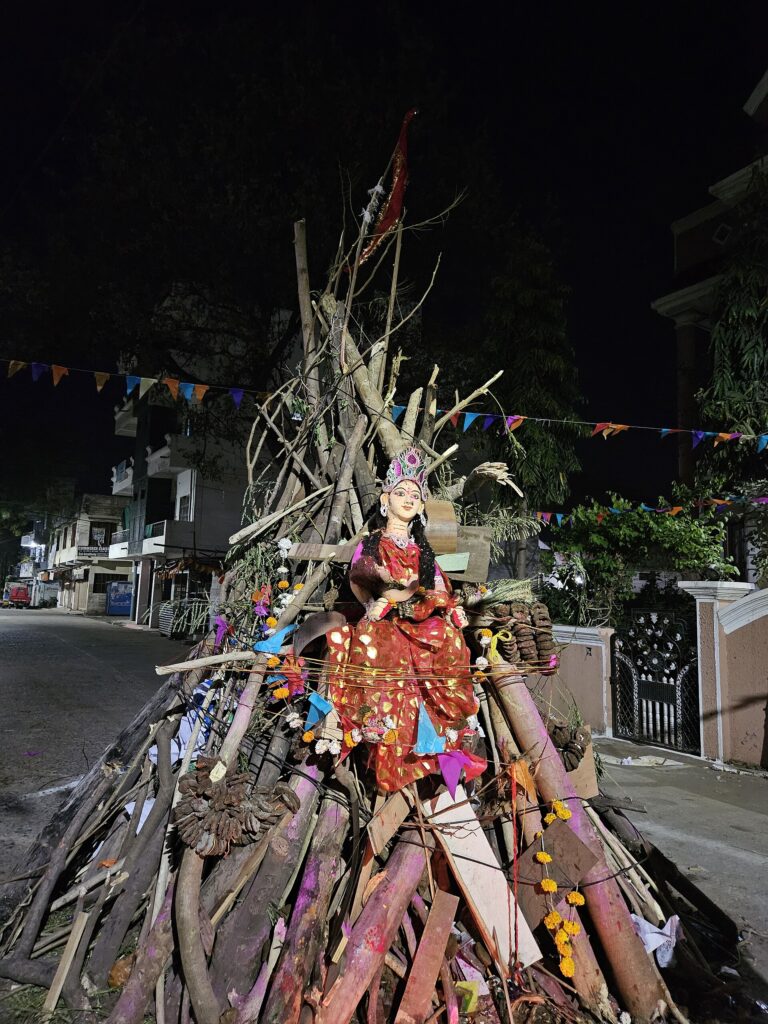
The festival runs across two days in most places. The evening before belongs to Holika Dahan, when neighbourhoods light bonfires to recall the legend of Holika, who tried to kill her nephew Prahlad in a fire and was burned herself while he survived. The main day is Rangwali Holi, when streets fill with coloured powder, coloured water and music.
The powder is called gulal, and it gets thrown, smeared and mixed with water until everyone in range wears the same colours. Behind the play sit two serious themes: the triumph of good over evil and the love of Radha and Krishna, retold in Britannica’s festival explainer.
Much of the colour arrives with water, which places Holi inside the wider family of spring water festivals around the world.
Holi is a public holiday across India, so schools and most offices close around the main days. Many households play at home first: parents apply colour to their children, food goes round all morning, and the bigger street party follows.
When is Holi celebrated in India?
Holi follows the Hindu lunar calendar, so the date changes every year, and it usually lands in March, on the full moon day of Phalguna, the last month of the Hindu year.
The Hindu calendar tracks moon cycles rather than the fixed solar year, and extra months are added every few years to keep the seasons aligned, so the festival drifts earlier or later from one year to the next.
In 2026, the main day fell on Wednesday 4 March, and millions of people celebrated across India and elsewhere, according to BBC News. For 2027 and beyond, the date follows the Hindu calendar and moves each year, confirm on the official site before you book flights.
The festival splits into two halves, and the first half matters even if you are only in town for the colour.
| Stage | Timing | What happens |
|---|---|---|
| Holika Dahan | The evening before the main day | Neighbourhoods light bonfires; in some places an effigy of Holika is burned to mark the legend. |
| Rangwali Holi | The main day | Gulal powder and coloured water go everywhere, with music, dancing and sweets behind the colour. |
If you are mapping out a year of festival travel, start with our global festival calendar and build the trip around the date. Booking calendars reflect it too: many travellers arrive a day or two before Holika Dahan so they see both halves of the festival.
Where to celebrate the Holi festival in India
The biggest celebrations play out in the Braj region of Uttar Pradesh, above all in Mathura and Vrindavan. Jaipur and Pushkar head the Rajasthan options, and smaller towns across the country run their own neighbourhood versions.
Mathura and Vrindavan
Mathura and Vrindavan run multi-day celebrations tied to the Radha and Krishna stories, and some years the programme stretches for a week or more. The colour play spills out of temples and into the streets, so both towns feel like one long festival by the main day.
They are small places, and rooms go first around the biggest dates, so book stays well ahead and expect full trains from Delhi in the days before.
Barsana and Lathmar Holi
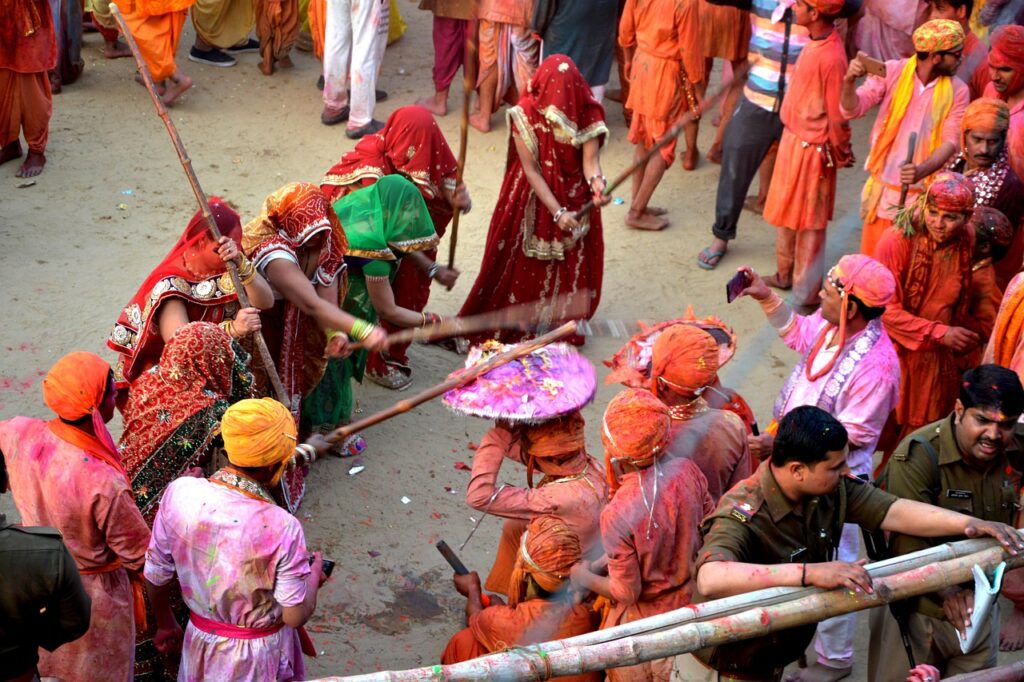
Barsana’s Lathmar Holi is the best-known regional variation of the festival. Women playfully strike men with wooden sticks, while the men, who travel in from neighbouring Nandgaon, defend themselves with shields. It takes place in the days before the main colour day, and the lanes get extremely crowded, so arrive early, stay clear of the sticks and ask before you photograph anyone.
Cover your camera and keep a firm grip on anything you want to keep clean.
Jaipur and Pushkar
In Jaipur, the colour play spreads through the old city and draws the largest Rajasthan crowds, with processions and music through the main day. Pushkar is smaller and slower, which suits travellers who want to take part without being caught in a crush. Plan around the main day here: the build-up days are quieter and easier for photos.
Elsewhere in India
Holi is celebrated nationwide, with the most intense street scenes in the northern and eastern states. Big cities mix the traditional street play with organised events at hotels and resorts, which are easier to join if you want food, music and a guaranteed exit at the end.
Wherever you end up, ask at your hotel which neighbourhoods are playing and which are keeping out of it.
What happens on the day
Colour play starts in the morning and most public celebrations wind down by mid-afternoon. People smear powder onto faces, throw it in the air and fire coloured water at anyone in range. Streets fill with music and dancing, and children ambush passers-by with water bombs from doorways and rooftops.
Water arrives from every direction, in guns, balloons and buckets, so keep your mouth shut when a cloud of powder lands on you and your eyes covered if they are sensitive. Expect food to circulate all day; sharing sweets is part of the ritual, so accept something small if you can.
By evening the public play is finished. Families eat, visit friends and wash up, and temple towns keep their own rituals running for days around that rhythm. Keep your group together in the biggest crowds, agree on a meeting point, and carry a little cash in a sealed bag for snacks and water.
What to wear and how to prepare
Wear white if you want the classic photos, but treat every item as disposable, because the colour does not always wash out. Choose light, covered clothing, old shoes you can hose down, and sunglasses to keep powder out of your eyes.
Leave the contact lenses in your room, seal your phone inside a plastic bag, and carry your own water. Hair holds colour longest, so tie it back or wear a cap. Back at the hotel, keep a spare outfit, a towel and a few bottles of drinking water waiting, and buy soft, natural powders where the choice exists rather than the cheapest chemical ones.
For the rest of the day bag, the festival packing list covers the essentials.
Holi etiquette: how to join in respectfully
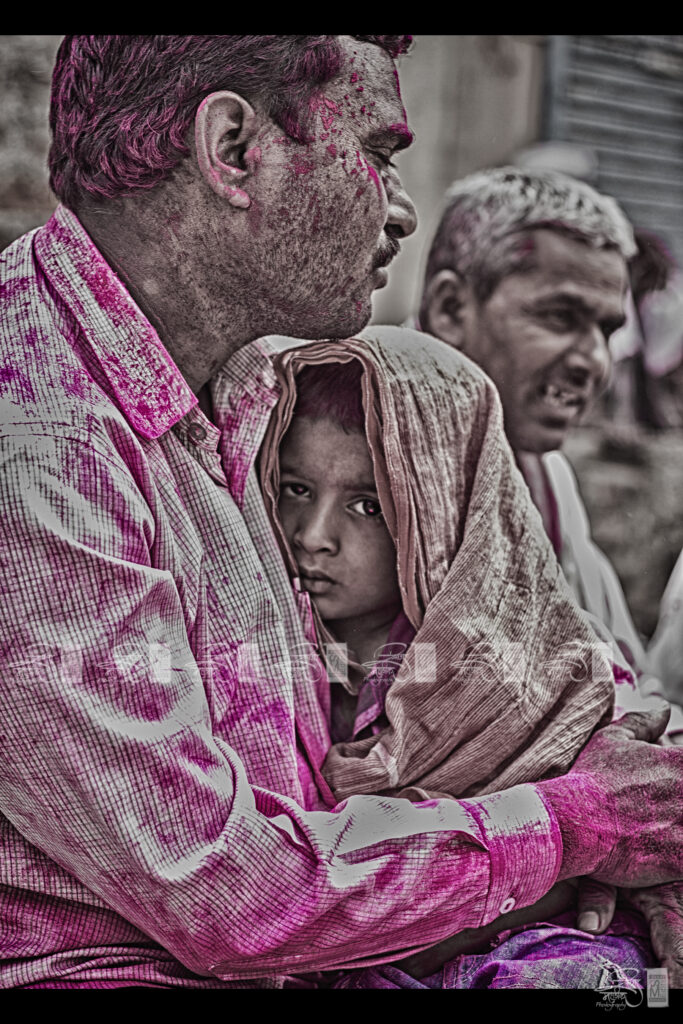
Ask before you smear colour on anyone, because not everyone wants to play. Some people and some neighbourhoods opt out, and that choice deserves respect. Keep your hands away from faces you have not been invited to touch, and never target someone on a scooter, an older person, or anyone holding a child.
Treat the religious parts as religious events. Holika Dahan and temple rituals are acts of worship first and photo opportunities second, so watch quietly and ask before you take someone’s photo. If you are staying with a family, let them lead: they will tell you when to play and when to sit it out.
One practical warning: some food and drinks served during Holi contain bhang, a cannabis preparation. If that is not for you, stick to sealed bottled drinks and ask what is on offer before you accept anything homemade.
For the wider ground rules that apply to any religious festival, the respectful visitor guide is the place to start.
Planning a Holi festival trip: stays, transport and costs
Book your bed first, because the towns at the centre of Holi have limited rooms and the main dates fill fastest. Pick one celebration and build the trip around it. Chasing three cities in one week usually means arriving somewhere after the colour has moved on.
Most travellers reach the Braj region through Delhi, then continue by train or by road. Domestic flights cover the longer hops, but build in buffer days, because travel during festival week runs slow and full. Between cities, book the long legs as soon as reservations open for your dates.
On cost, the big variables are your flights from Australia, the standard of stay you choose and how early you book. If you would rather not navigate the crowds alone, guided Holi experiences bundle transport, a local guide and a place to leave your bags; check what is included before you pay, because food and a wash-up point are not always part of the price.
Once your dates are firm, confirm the festival details on India’s official tourism site before you lock in anything non-refundable.
Should you plan a trip around Holi?
Yes, if you want a festival you can join rather than watch. Holi is one of the few events of this size where visitors are participants by default, and the price of entry is preparation: the right city, the right week, sacrificial clothes and basic etiquette. Get those four right and the rest of the trip falls into place.
Ready to work out what the whole trip costs? Start with the festival budget breakdown.
Frequently asked questions
How do you get Holi colour off your skin?
Oil your skin and hair before you play, then wash with warm water and a mild soap. Most colour lifts within a few washes, though strong powders can linger for a few days.
Rinse irritated eyes with clean water rather than rubbing them.
Do you need tickets for Holi?
No, the street celebrations are public and open to anyone. Ticketed Holi events do exist at hotels, resorts and through tour operators, so a ticket only matters if you choose a managed setting.
Can non-Hindus take part in Holi?
Yes. Holi began as a Hindu festival, but it is celebrated as a public event, and visitors join in across India every year.
Follow the etiquette: ask before you apply colour, and leave anyone who opts out alone.
Is Holi celebrated outside India?
Yes. Nepal marks its own version of the festival, and cities with large South Asian communities, including London and New York, run public Holi events each year.
How long does the Holi festival last?
The colour play itself is usually one day, following the bonfire night. In the Braj towns around Mathura, the wider celebrations can run for a week or more, so plan your travel days around the full programme.
Image credits
- Photo: Narender9 / Wikimedia Commons, CC BY-SA 3.0. Source
- Photo: Shoot stufz / Wikimedia Commons, CC BY-SA 4.0. Source
- Photo: Naman990 / Wikimedia Commons, CC BY-SA 4.0. Source
- Photo: sagarmahadikphotography / Wikimedia Commons, CC BY-SA 3.0. Source
Works Cited
Mollan, Cherylann. “Celebrating Holi – the Hindu festival brings its array of colours to India and elsewhere.” BBC News, BBC, 4 Mar. 2026, https://www.bbc.com/news/articles/cq6qvvnj1jvo.
“Holi: Festival of Colors.” Encyclopaedia Britannica, Encyclopaedia Britannica, Inc., n.d., https://www.britannica.com/story/holi-festival-of-colors.
“Holi: Celebrate the festival of colours.” Incredible India, Ministry of Tourism, Government of India, n.d., https://www.incredibleindia.gov.in/en/festivals-and-events/holi.
Wilson, Asya. “Holi festival guide: Where to celebrate around the world in 2026.” GetYourGuide, GetYourGuide, 22 June 2026, https://www.getyourguide.com/explorer/travel-inspiration/holi-festival-guide/.