
The short answer
A good island trip gets decided before you book the flight: which months are dry, which coast suits your budget and your sleep schedule, and how far you will travel for a waterfall or a temple. This guide works through the season logic first, then the areas worth basing yourself in, the transport that actually moves you around, and the nature and culture stops that deserve a full day each. Read it in order, or jump to the section you need.
What Koh Samui is, and where it sits on the map
Koh Samui is the biggest island in the Gulf of Thailand, sitting off the country’s south-east coast, about an hour by air from Bangkok. That position shapes the whole trip: the weather, the ferry routes and the kind of holiday you can build here.
A ring road circles the entire island, and that detail matters more than it sounds. You can base yourself on one beach and still reach temples, waterfalls and viewpoints on the far side within an hour of driving. On smaller Thai islands you are effectively tied to a single bay.
Samui also has a backpacker history that reaches back to the 1970s, though it does not feel like a budget stop today. The east coast, anchored by Chaweng, holds the large resorts. The north and west coasts are quieter and greener, with fishing villages that still work for a living.
When to visit Koh Samui: the Gulf monsoon runs its own clock
Koh Samui’s dry, calm window runs from roughly December to April, and its wettest stretch falls from October to December. That is the reverse of the pattern on Thailand’s Andaman coast, where heavy rain arrives in the middle of the year.
If you want the surest weather, aim for January to April. Early December can still catch the tail of the wet season, and October to November is when long downpours and rough seas are most likely.
Rough water matters for a practical reason: boat trips to the marine park get cancelled when the swell is up, so keep the boat day out of October and November if it is the point of your trip.
Travelling in the wet season is not wasted time. Room rates drop, the island empties out and the waterfalls run strongest. You just need a flexible plan and a tolerance for afternoon rain.
| Window | Koh Samui (Gulf coast) | Phuket and Krabi (Andaman coast) |
|---|---|---|
| December to February | Dry, calm seas, peak-season prices | Dry and cooler by Thai standards, high season |
| March to April | Hot and mostly dry, school holiday demand | Hot; the first rains usually arrive late in April |
| May to September | Passing showers, manageable heat, better rates | South-west monsoon; wettest from June to September |
| October to November | Wettest stretch; rough seas, boat cancellations | Rain eases; high season returns from November |
Where to stay: Chaweng, Lamai, Bophut and the quieter coasts
Pick your base by what you want from the evenings: Chaweng for nightlife and a first visit, Lamai for a calmer beach with its own restaurant strip, Bophut for dining and a village feel, and the north and west coasts for quiet and space.
Chaweng is the island’s commercial centre. The beach is long and good, and everything you might need sits within walking distance, which is also why traffic crawls here after dark.
Bophut, built around Fisherman’s Village, keeps the bones of an old fishing community. The night market, the seafront restaurants and the small beach make it the base many returning visitors choose over Chaweng. Waterfront rooms cost more, and the beach itself is shorter.
Lamai sits between the two: big enough for a proper beach day, quieter than Chaweng at night. Head north or west and the pace drops again, with longer beaches, sunsets over the water and fewer restaurants, so factor in a scooter or a taxi for dinner.
| Area | Best for | Trade-offs |
|---|---|---|
| Chaweng | First visits, nightlife, long beach days | Busiest and loudest; evening traffic |
| Lamai | Beach days plus village restaurants and bars | Still lively; fewer big-resort facilities |
| Bophut / Fisherman’s Village | Couples, dining, evening walks | Short beach; higher rates on the seafront |
| North and west coasts | Quiet stays, sunsets, longer trips | You need transport for most meals and trips |
How to get to Koh Samui, and why seats fill early
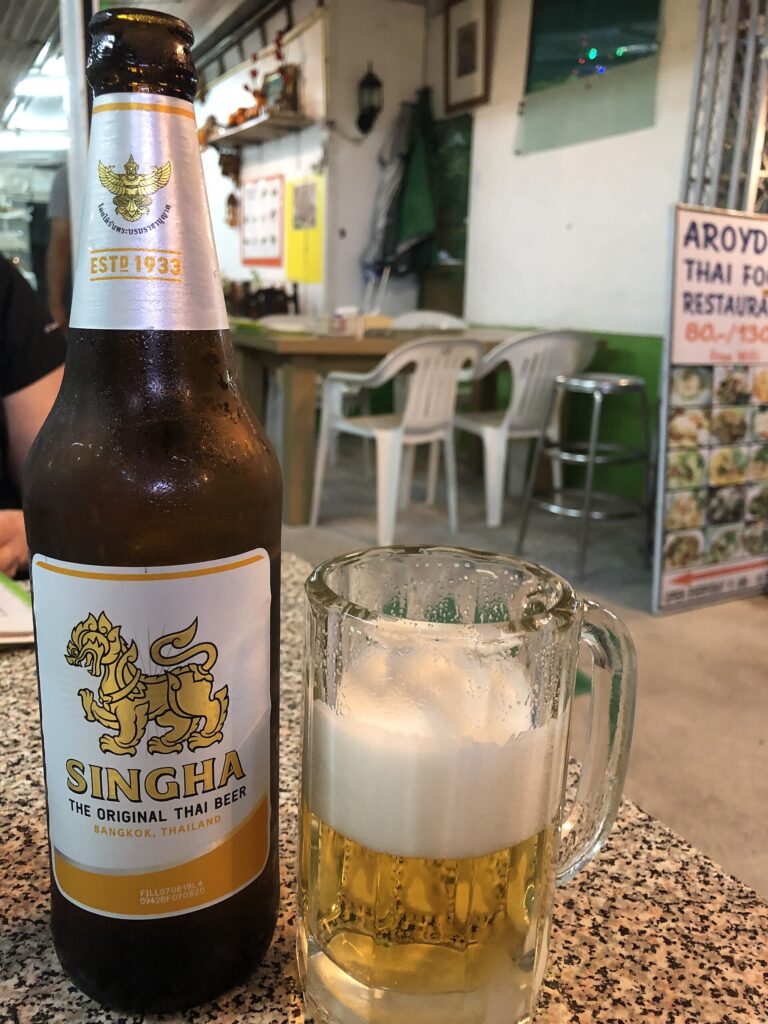
Most visitors fly into Samui’s own airport, about one hour from Bangkok, or arrive by ferry from the mainland or a neighbouring island. The airport is the bottleneck: it is small, privately run and served by planes sized for short hops rather than wide-body loads.
That limited capacity has a planning consequence. In the December to April high season, and around Christmas, New Year and Thai public holidays, seats sell out well in advance and fares climb as the date approaches. If your dates are fixed, book the flight before you book the hotel.
The alternatives are slower and cheaper. Fly to Surat Thani on the mainland and continue by bus and ferry, or arrive by boat from Koh Phangan or Koh Tao. Combined bus-and-ferry tickets are the standard budget route, and they are worth pricing before you commit to the airfare.
If Samui is one stop on a longer Thai trip, sort the wider route first with Discover Thailand’s Must-See Destinations Now, then work backwards to your flight dates.
Getting around the island without overpaying
Three options cover almost every trip: shared songthaews, taxis and a rental scooter. Distances are short, the ring road connects everything, and the only real problem is traffic through Chaweng at peak times.
Songthaews, the red trucks that circle the island, are the cheapest way to cover a stage of the ring road. Wave one down, say where you are going and agree the fare before you get in, because there is no meter and no fixed tariff for visitors.
Taxis and hotel cars are the comfortable option and the most expensive per kilometre. Treat every fare as a negotiation, and ask your hotel what a route should cost before you set out. Ride-hailing apps have patchier coverage here than in Bangkok.
Scooters rent widely and give you the most freedom for waterfalls, viewpoints and beaches off the main road. Two cautions: Thailand drives on the left, and the interior roads are steep and shaded. If you are not licensed at home, check whether your travel insurance covers you before you ride.
Beaches and viewpoints worth the drive
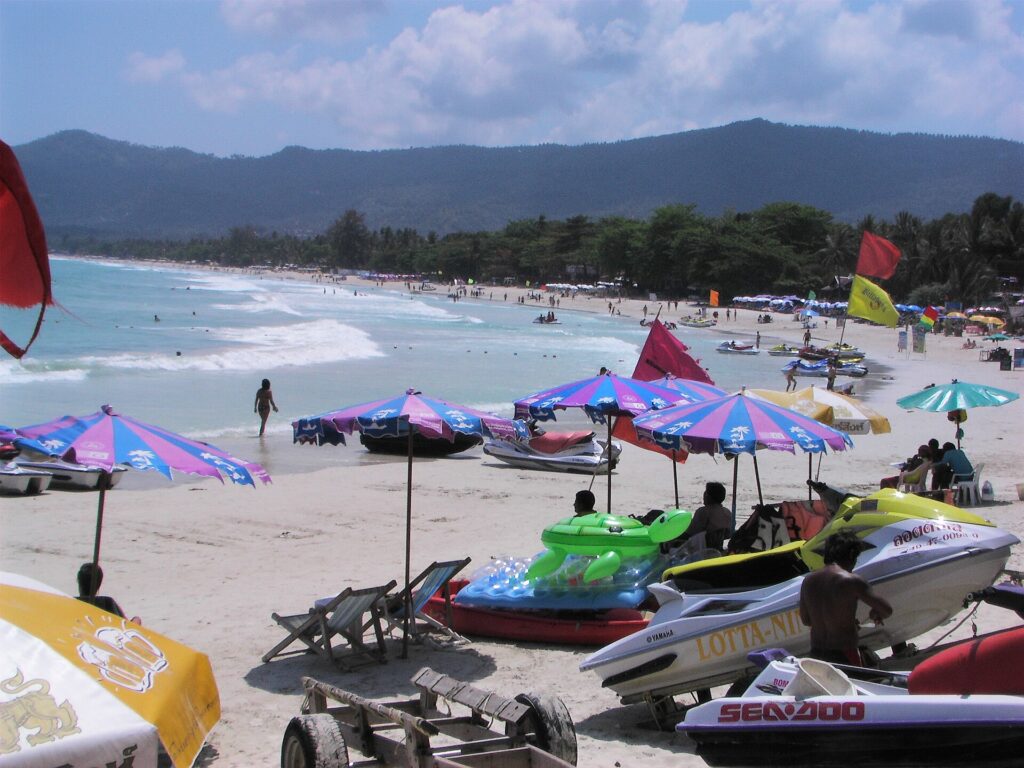
Chaweng and Lamai are the two big beaches, and the island’s best views are usually found on the road between them rather than on the sand. Both stretch along the east coast, so mornings are bright and the sunsets happen on the other side of the island.
Chaweng is the long, busy one: fine sand, plenty of beach bars, and views across to Koh Matlang at its northern end. Lamai is broader and slower, with the Hin Ta Hin Yai rock formations at its southern end, where granite boulders have weathered into shapes with their own local legend.
Between the two, Silver Beach is a small cove that rewards a stop, and the Overlap Stone viewpoint further south shows one massive boulder balanced on another with the coast behind it.
The ring road viewpoints cost nothing. Lad Koh, on the climb between Chaweng and Lamai, looks back over the bay and is the standard photo stop on any island circuit.
Temples and the culture stops that anchor a trip
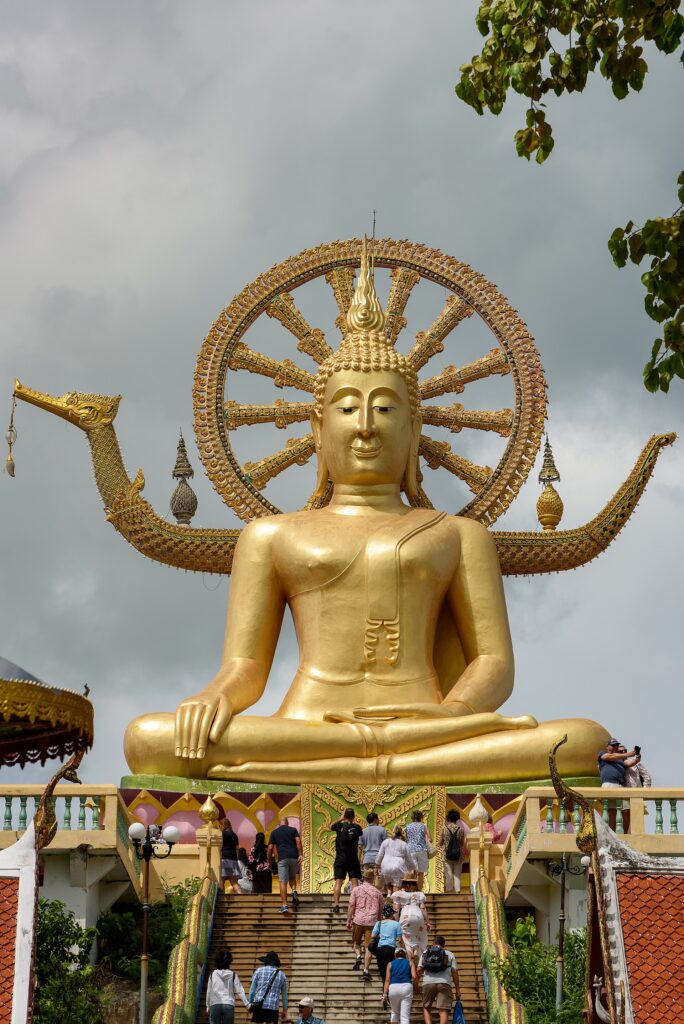
Samui’s temple stops are easy to visit and mostly free to enter, and the two on the north-east coast pair naturally in one morning. Wat Phra Yai holds the island’s best-known landmark, a large golden seated Buddha that faces the sea and is visible long before you reach it.
Wat Plai Laem is a short drive from the Big Buddha and covers a different register: a temple complex built around a lake, with a large statue of Guanyin and a smiling Buddha at its centre. Both sites are working temples, so dress for them.
Wat Khunaram, in the island’s south, houses the preserved body of a monk kept in a seated meditation posture, displayed in a glass case. It is a genuine religious site rather than an attraction, and visitors are asked to behave accordingly.
Etiquette is simple but enforced by custom. Cover shoulders and knees, remove your shoes before entering temple buildings, keep your feet pointed away from Buddha images, and stay quiet around anyone praying. No ticket is needed at most sites, though donations are welcome.
For a deeper route through the island’s non-beach side, read Koh Samui: Unforgettable Nature, Culture, and Adventure.
Waterfalls and jungle gardens
Na Muang Waterfall 2 is the island’s easiest swim stop, and the Secret Buddha Garden shows you the interior hills without a long trek. Both sit in the island’s south, within easy reach of Lamai.
Na Muang covers two falls on one road. Na Muang 1 drops into a pool you can see from the car park; Na Muang 2, a short drive further on, has the larger swimming basin and the better views. Flow depends on the season: after rain the falls run loud and full, while late in the dry months they can thin to a trickle.
The Secret Buddha Garden, sometimes called the Magic Garden, is a hillside collection of statues, shrines and animal figures created by a local farmer. The road up is steep and shaded, there is a small entry charge, and the reward is a quiet walk among weathered figures with the coast far below.
Go early. The hillside heats up by mid-morning and tour minivans arrive in waves around lunchtime.
Ang Thong Marine Park and the neighbouring islands
Mu Ko Ang Thong Marine Park is the boat day most visits should include: dozens of limestone islands, a hidden emerald lagoon and a viewpoint climb that shows you the whole archipelago. Tours leave from the island’s piers, usually as speedboat day trips with snorkelling stops and lunch included.
The highlight is Ko Mae Ko, where a steep staircase leads up to the viewpoint over the emerald lagoon, a saltwater lake enclosed by limestone walls. Marine parks are where What is Eco-Tourism stops being abstract: do not touch coral, do not feed the fish, and take your rubbish back to the boat.
Weather decides everything. Trips run through the drier months and are cancelled when the sea is rough, so treat a boat day in October or November as a bonus rather than a plan. A national park fee applies on top of the tour price.
Samui is also a base for the islands around it. Ferries connect to Koh Phangan, home of the Full Moon Party and a much quieter interior, and to Koh Tao, a longer crossing that divers use as a training base. Both work as day trips, but a night on either beats a rushed return.
For the quieter side of the island next door, see Discover Koh Phangan: Beyond the Party.
The short version: a five-day shape for your trip
Five days is the comfortable shape for Samui: two beach days, one temple and waterfall loop, one boat day, and one spare for an island hop. Here is how that looks.
- Day 1: Land, settle into your base, and eat at the nearest night market.
- Day 2: Beach and viewpoints on your own coast, with Lad Koh on the way back.
- Day 3: Big Buddha and Wat Plai Laem in the morning, Na Muang falls in the afternoon.
- Day 4: Ang Thong boat day.
- Day 5: Ferry to Koh Phangan, or a slow morning and dinner in Chaweng before the flight home.
The only booking that needs real lead time is the flight into the island airport. Boat trips, scooters and rooms can usually be arranged a day or two ahead outside the peak months.
Ready to put numbers on the trip? Start with Travel Budget Planning: Tips & Tools before you book anything.
Frequently asked questions
Is Koh Samui worth visiting?
Yes, particularly if you can travel between December and April. The island pairs proper beaches with temples, waterfalls and a marine park, and the ring road makes all of it reachable in a day.
How many days do you need in Koh Samui?
Four or five days covers the island and a boat trip. Three days is enough if you rent a scooter and skip the day trips, while a week lets you add Koh Phangan or Koh Tao.
What is the best time to visit Koh Samui?
January to April is the safest bet for dry, calm weather. The heaviest rain falls from October to December, when rates drop but boat trips are often cancelled.
Do you need a scooter in Koh Samui?
No. Songthaews and taxis cover the island, though a scooter is the cheapest way to reach viewpoints and waterfalls. Roads are steep, and traffic drives on the left.
Is Koh Samui or Phuket better?
They suit different calendars more than different tastes. Samui is at its best from December to April, while Phuket’s dry season runs from about November to April and the Andaman side has far more flight capacity.
Image credits
- Photo: Dan arndt / Wikimedia Commons, CC BY-SA 4.0. Source
- Photo: User: (WT-shared) Wipkinger at wts wikivoyage / Wikimedia Commons, Public domain. Source
- Photo: Mustang Joe / Wikimedia Commons, CC0. Source
- Photo: Abrget47j / Wikimedia Commons, CC BY-SA 3.0. Source
Works Cited
Moggia, Silvia. “Koh Samui: The Thailand Beach Island That Won Me Over.” Silvia’s Trips, 22 Aug. 2026, https://silvias-trips.com/the-island-of-koh-samui/.
“Koh Samui Travel Guide 2026: 16 Best Things to Do.” In Between Travels, 12 Aug. 2026, https://inbetweentravels.com/koh-samui-travel-guide-thailand/.
“Muko Ang Thong Marine National Park.” Tourism Authority of Thailand, https://www.tourismthailand.org/Attraction/muko-ang-thong-marine-national-park. Accessed 14 Sept. 2026.